
The staircase dispute: Will Barcelona demolish 1,000 homes to complete Gaudí’s masterpiece?
The staircase dispute
Will Barcelona demolish 1,000 homes to complete Gaudí’s masterpiece?

The conflict between the Sagrada Família and local residents
Imagine buying a home in one of the world’s most beautiful cities, only to be told years later that a cathedral’s grand entrance is planned to run right through your living room. It sounds like a nightmare, but for 3,000 residents of Barcelona, it is a lived reality.
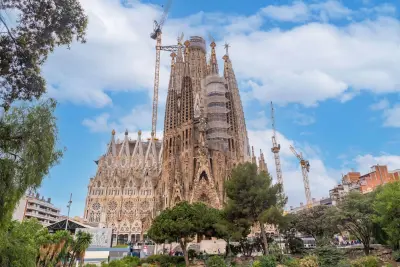
2026 is a milestone year for the Sagrada Família, as the central Tower of Jesus Christ finally reaches its record-breaking height. The world is watching in amazement, but just across the street, a different story is unfolding. The Sagrada Família Foundation plans to build a 60-meter-wide staircase connecting the basilica to Avinguda Diagonal. To clear the path, they propose plans that would involve the potential demolition of several established city blocks, displacing around 3,000 people and affecting around 50 local businesses. While the church argues that completing Gaudí’s vision is a historical obligation, the residents are fighting back in court, arguing that they have the right to keep their legally purchased homes. With the Barcelona City Council caught in the middle, the fate of an entire neighborhood hangs in the balance.
The issue has sparked countless debates, and the question remains: Does preserving cultural heritage justify destroying the surrounding community?

Why Sagrada Família’s neighbors are suing to stay
Here is what we know so far regarding the origins of this conflict:
1975 – Legal construction of the apartment blocks: The city of Barcelona granted official, legal municipal building permits for the apartment blocks directly facing the Glory Façade, including the large Núñez y Navarro building.
1976 – The zoning conflict: Just one year later, the city passed an urban zoning plan called the Plan General Metropolitano (PGM). This plan officially reserved the exact same space over Carrer de Mallorca for the Sagrada Família’s future staircase.
The 1980s – Buying in the dark: Families purchased these apartments throughout the late 1970s and 1980s. Because the buildings held valid 1975 permits, there were no warnings on their property deeds indicating the city had already rezoned their block for future demolition.
1992 – The hard truth: Many residents lived completely unaware of this for years. In 1992, as Barcelona reviewed urban plans to prepare for the Summer Olympics, the city’s 1976 zoning design finally resurfaced. This was the moment many residents realized their legally purchased homes were secretly marked for future demolition to make way for the church’s staircase. That shocking discovery transformed homeowners into an organized community, sparking the legal fight that has continued for over three decades. Salvador Barroso, the current chairman of the residents’ association fighting the eviction, publicly stated he bought his apartment in the 1980s but only learned about the potential demolition plan in 1992.

The legal showdown
The long-standing political standoff over the Sagrada Família’s expansion officially moved from the streets to the courtroom in 2018.
When city and church officials attempted to finalize urban planning permits for a new staircase, the “Association of People Affected by the Construction of the Sagrada Família” filed formal legal challenges against these new plans. The neighborhood association’s defense rests on a discrepancy in the timeline, and the city is relying on a 1976 zoning rule to justify demolishing homes that had received legal building permits in 1975.
The residents’ lawsuit aims to prove that private property rights supersede the church’s desire to expand. Residents argue that although the foundation owns the basilica, it lacks legal authority to carry out the planned expansion. The demolition plans are deadlocked in court, leaving the neighborhood in uncertainty.

The historical enigma: What did Gaudí actually want?
The entire justification for clearing the apartment blocks relies on a disputed piece of history.
- The Basilica’s point: The church’s construction board insists that Antoni Gaudí’s 1915 master plan always included this massive staircase.
- The missing evidence: The problem is that Gaudí’s original 3D plaster models and blueprints were destroyed in a fire set by anarchists during the Spanish Civil War in 1936. Today’s architects are working off reconstructed fragments.
- The neighborhood’s counter-proof: The residents’ defense relies on a 1975 memo from the Ministry of Culture, which explained that Gaudí’s very first plans from 1885 kept the basilica entirely on its own block, without expansion into the streets. Because the later sketches were destroyed in the fire, there is no hard evidence that he ever intended to expand the building. The Ministry concluded that the controversial 60-meter staircase was likely an invention added by his followers later on.
Respecting the horizon
Antoni Gaudí insisted that the Sagrada Família must never be taller than Montjuïc, a local hill that stands at 185 meters. He believed that no man-made structure should rise higher than God’s natural creations. At 172.5 meters, the new central tower respects this limit, showing that even in his boldest designs, Gaudí valued humility.

UNESCO and the heritage dilemma
Adding to the controversy is the basilica’s UNESCO World Heritage status. But, UNESCO protects only the older parts of the church that Gaudí built while he was alive (the Crypt and the Nativity Façade). While UNESCO does not have the authority to prevent the construction of the Glory Façade, it monitors any impact on the site’s “Outstanding Universal Value”. Demolishing functioning city blocks to build a 21st-century interpretation of a contested 1915 sketch puts UNESCO in an awkward position, sparking intense debates among Spaniards and the international community.

The political standoff and the relocation plans
Barcelona’s city government, led by Mayor Jaume Collboni, is caught in the middle. It has consistently maintained publicly that the burden of this project cannot fall on the city. In high-level reporting, including coverage by El País, it has been emphasized that if the Glory Façade staircase project proceeds, the Sagrada Família Construction Board would be legally and financially responsible for all costs associated with displacement.
The Sagrada Família Foundation, which brings in tens of millions of euros a year from tourists, has indicated that it would cover the costs, though a final, legally binding agreement has not yet been executed by the City Council.
Interestingly, the church quietly bought a large, empty plot of land just a block away in 2019. While the church claimed it was just for storage, many suspected they were laying the logistical groundwork for a future relocation plan.

The current situation
The milestone: On February 20, 2026, the central Tower of Jesus Christ reached its full structural height of 172.5 meters. The city is currently finalizing preparations for a commemorative mass and ceremony on June 10, 2026, which marks the centenary of Antoni Gaudí’s death.
What remains to be built: While the exterior of the central towers is now complete, the basilica is far from done. Construction has moved to the interior details and the highly controversial Glory Façade.
The deadlock: The dispute over the Glory Façade’s grand staircase remains completely unresolved. While the basilica focuses on interior work through the late 2020s, the staircase is the main issue likely to dominate the project’s next decade, with total completion now estimated for 2034-2035.
Ultimately, the power to decide the fate of Carrer de Mallorca lies not with a single person but with the Barcelona City Council, which is the only body with the legal authority to approve the final demolition permits. However, they are not acting in a vacuum. The process is currently a three-way standoff:
- The Sagrada Família Foundation – pushing to complete the basilica according to their interpretation of Gaudí’s vision.
- The Residents’ Association – using the judicial system to challenge the validity of those plans, effectively putting the “final decision” in the hands of the courts.
- The City Council – acting as a reluctant mediator, caught between the desire to complete a global monument and the legal, moral duty to protect thousands of citizens whose homes are at risk.

The final ethical question: art or people?
This brings us to the ultimate question: What matters more, the city’s past or its people?
On one side, we have the Sagrada Família. It is a world-famous landmark, and many argue that finishing it is a historical duty. On the other side are the residents of Carrer de Mallorca, the people who actually live in and run the city.
The fate of this neighborhood presents a serious challenge for Barcelona. Will the city choose to destroy real homes to build a monument to the past, or will it find a way to honor Gaudí’s legacy without displacing the people who live in his shadow? Ultimately, Barcelona must decide if its true essence lies in its iconic stone spires or in the people who reside beneath them.
PRO TIP
Curious to see what all the fuss is about? Book the Sagrada Familia Tour and decide for yourself: is the masterpiece worth the cost?
Your expert guide will show you exactly where the controversial grand staircase is planned to go. It is the best way to understand the clash between architectural genius and the reality of everyday city life.
Plan to visit Sagrada Família soon?
Make sure to check out our visiting guide first!

We have the best value Sagrada Familia tours & tickets for you!

Skip-the-Line
Sagrada Família Fast-Track Ticket with Tower Access
Discover one of Barcelona’s most iconic landmarks at your own pace. Enjoy fast-track access to Gaudi’s stunning Sagrada Família Basilica and explore its architecture and towering spires. See the tall columns resembling trees and beautiful stained glass windows filling the space with color. View the detailed carvings on the exterior facades and explore Gaudi’s unique designs inspired by nature.

Priority access
Sagrada Família Private Tour
Experience the iconic Sagrada Familia in Barcelona at your own pace with a private tour tailored to your interests. Enjoy fast-track entry and a personalized journey with an expert guide. Discover Gaudi's visionary masterpiece, completed in 2026 after more than 140 years of construction, including its hidden symbols and forest-like interior. See the stunning stained glass windows, monumental towers, and facades with intricate sculptures and learn about the meaning behind every detail. Learn about Gaudi's life, his impact on Catalan art, and his lasting legacy.

Gaudí’s masterpiece
Sagrada Família Guided Tour
Join a Sagrada Família Guided Tour and explore the famous basilica without waiting in the regular ticket lines. Follow your guide through the beautiful interior and admire the colorful stained-glass windows. You will see the impressive facades, the main nave, and the sanctuary. The experience also features a walk through the museum, where you can study original sketches and models. Secure your spot today and discover the architectural secrets of architect Antoni Gaudí.