
Gaudí’s architecture in Barcelona: Must-see masterpieces
7 Famous Gaudí’s buildings in Barcelona

Gaudí’s buildings in Barcelona
Have you heard about the beautiful church that took more than 140 years to build and was completed in 2026? What about the skeletal Modernist house lacking a single straight line? Have you seen pictures of the long, serpentine, and colorful bench overlooking Barcelona?
The monuments we are talking about are: the Sagrada Família, Casa Batlló, and Park Güell. They were all designed by Antoni Gaudí. The architect was famous for his unique architectural style. It features highly animated surfaces and natural and religious symbolism. His buildings stand independently without external buttressing or internal bracing. Each and every one of his buildings is worth a visit, but there are a few masterpieces that stand out. Read on to learn about these UNESCO World Heritage sites: the seven wonders of Gaudí!

1. Sagrada Família
When you think of Gaudí architecture in Barcelona, the Sagrada Família usually comes to mind first. The church is widely regarded as Gaudí’s best work, and the architect spent the last 12 years of his life working exclusively on its construction.
The church’s first cornerstone was laid in 1882. More than 140 years later, the basilica reached its final height in 2026, completing Gaudí’s vertical vision. When Gaudí passed away in 1926, only the crypt, apse, one bell tower, and the Nativity façade had been completed. La Sagrada Família has the unique organic form typical of Gaudí’s work. Unlike traditional Gothic cathedrals, the structure does not rely on prominent external buttresses or internal bracing. Instead, its 18 towers (each representing a biblical figure) rise above the city as part of Gaudí’s innovative structural design. But perhaps most striking is the nave. It is filled with countless columns and softly illuminated by glittering stained-glass windows. The columns are designed to resemble trees and branches, and as you stare up, you’ll feel like you’re in a forest. The effect is achieved by Gaudí’s insistence on completely avoiding straight lines. He claimed, “there are no straight lines in nature.” And he was fully dedicated to the philosophy – even the church’s iron balconies boast curves!

2. Park Güell
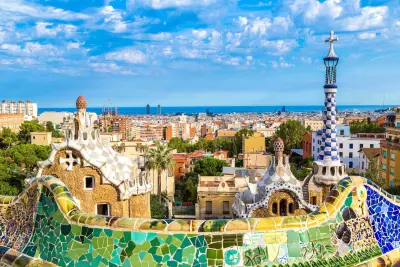
Gaudí didn’t only work on buildings. He was also a master at the architecture of outdoor spaces. He weaved together parks, gardens, and other elements into relaxing open-air sites. Park Güell is the best example. Gaudí successfully designed a relaxing compound, mixing green vegetation and colorful imagery. For example, right at the entrance, you’ll see a multicolored, vibrant salamander statue, commonly called El Drac. The stonework also evokes natural associations, in typical Gaudí style. All of the park’s elevated pathways are constructed from local stone. Gaudí envisioned them as an extension of the landscape. Furthermore, the supporting columns and vaults are carved to resemble tree trunks.
You’ll also see Gaudí’s piety at Park Güell. At the park’s highest point, there are three crosses, representing Christ’s Crucifixion. From here, you’ll enjoy breathtaking panoramic views of Barcelona city. But, funnily enough, the park’s most famous feature, a long, colorful, and gently-curving bench shaped like a serpent, isn’t even Gaudí’s creation! It’s actually the work of his disciple, Josep Maria Jujol i Gibert.
Want to visit these Gaudí’s masterpieces?

Gaudí’s masterpiece
Sagrada Família Guided Tour
Join a Sagrada Família Guided Tour and explore the famous basilica without waiting in the regular ticket lines. Follow your guide through the beautiful interior and admire the colorful stained-glass windows. You will see the impressive facades, the main nave, and the sanctuary. The experience also features a walk through the museum, where you can study original sketches and models. Secure your spot today and discover the architectural secrets of architect Antoni Gaudí.

Barcelona art treasures
Gaudí Tour Barcelona
Go on the ultimate Gaudí tour and explore the architect’s most iconic buildings with a knowledgeable guide and transportation! You can see Casa Batlló, Casa Vicens, Casa Milà, known as La Pedrera, and Casa Amatller. You can also skip the line at Park Güell and enter the famous La Sagrada Família.

3. Palau Güell
Although Palau Güell is a lesser-known example of Gaudí architecture, Barcelona is still definitely lucky to have it. The building was Gaudí’s first commission from textile tycoon Eusebi Güell. It is also a great example of how even the architect’s ‘simpler’ buildings follow his style. Across the street from Palau Güell stood the Edén Concert Hall, boasting an extravagant facade. As such, Gaudí decided a clean, smooth look on Güell’s palace would work best.
However, there are still classic Gaudí elements. For example, there are two huge entrances enclosed by catenary arches. Their doors are decorated with the architect’s favorite typical natural elements: plants and animals. Furthermore, if you crane your neck to look at the very top of the building, you’ll see four spires that highly resemble trees sprouting from the roof. One of them is even green! When visiting, take a careful look at the two entryways. You should find a small lattice. It is a contraption that lets the palace’s residents see what was happening on the street without being seen themselves.

4. Casa Milà
When Gaudí first built Casa Milà, the building was criticized for its unconventional look, with many calling it “weird”. Today, the residence is a highlight of Gaudí architecture, Barcelona, and Modernism more generally. As soon as you see the house, you’ll understand the “weird” label. The stone facade softly curves inwards and outwards in a gentle wave motion. It looks like a completely natural stone formation! Hence, the building’s mocking nickname: “La Pedrera”, meaning stone quarry. In typical Gaudí style, this facade is completely self-supporting and free of load-bearing walls. Dotted throughout the facade, you’ll spot 32 gorgeous, ornate iron balconies. Each balcony is unique, twisting along with the facade’s curve, and they’re all made out of scrap iron sheets, chains, and bars. However, as with all Gaudí’s works, you’ll find natural elements on each balcony.
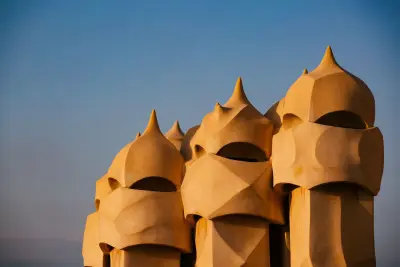
Finally, try to visit the building’s creamy-colored roof terrace. The staircases, ventilation towers, and chimneys are probably the most beautiful ones you’ll ever see in your life. They’re all fully functional but lack straight lines, instead dreamily twisting in soft curves.
PRO TIP
Thinking about how you’re going to get to all of these attractions? Get our Hola Barcelona Travel Card for unlimited access to all kinds of public transportation. It is a money saver!


5. Casa Vicens
Gaudí’s first major project, Casa Vicens, is a must-see for everyone interested in Orientalism. Gaudí’s Orientalist period lasted from 1883 to 1888, and Casa Vicens is its best example. The facade is made out of iron, brick, and wood, as well as ceramic green and white tiles positioned in a checkerboard pattern. Ceramics are characteristic of Eastern and Islamic architecture. These tiles even depict Moorish carnations. This is in line with Gaudí’s fascination with nature. That being said, when you first look at the building, the color red is probably what will catch your eye. Throughout the entire building, exposed brick dominates: on the facade, on the rooftop, in the garden, and also inside some rooms. Brick is characteristic of Moorish architecture, further increasing the oriental associations.
Finally, dome-shaped finishes, inspired by the iconic domes of Islamic mosques, are scattered throughout the house. This is most notable on the roof terrace, where beautiful green-and-white tiled domes top the walls and soar into the sky. You’ll even find a false dome in the living room!
See more, spend less! Book our best Barcelona tickets & tours!

Combo deal
Sagrada Família and Park Güell Tickets and Tour
Explore Barcelona's top landmarks with a guided tour of Sagrada Família and Park Güell. Skip the lines and discover Gaudi's stunning designs with an expert guide. At Sagrada Família, view the Nativity and Passion Facades, colorful stained glass, and tall columns that look like a forest. In Park Güell, walk through colorful mosaics, wave-like tunnels, and winding paths. Visit Gaudi's former home and enjoy stunning city views. This tour is a great way to experience Gaudí's most famous works and hear the stories behind them.

Access to top sights
Barcelona Pass
Get your money’s worth with our Barcelona Pass! With this ticket, you can visit Barcelona's top attractions such as Sagrada Família, Park Güell, and the Gaudí House Museum, Camp Nou, and Casa Batlló. You can also enjoy a Hop-On Hop-Off Bus to see the city, expert guides, skip-the-line access, and more. Get ready to see Barcelona’s highlights!

6. Casa Batlló
Located on the Passeig de Gràcia is Casa Batlló. Mixing white stone, glass, and ceramics, Casa Batlló is often called “The House of Bones”, and you’ll understand why when you see it. It is a masterpiece of Gaudí architecture, Barcelona, and maybe all of Spain. The house incorporates a flowing stone facade and skeletal stone columns that highly resemble bones.
On the facade, Gaudí placed broken ceramic tiles colored gold, orange, green, and bright blue, creating an undefined mosaic. Try and visit during the day, with the sun shining on the ceramic – the entire facade sparkles! Combined with the wavy shapes, oval windows, and curved roof, you almost feel like you’re looking at a magical sea world. Ensure you also pay attention to the roof. The very top of the building is covered in multi-colored scales, and the roofline is an elegant, gorgeous arch that resembles a dragon’s back. The symbolism goes deeper with the four-armed cross on the roof. It resembles a sword, and, as such, the roof is widely believed to represent the legend of St. George slaying an evil dragon.

7. Church of Colònia Güell
Last but not least, the Church of Colònia Güell is the final masterpiece by Gaudí included in the UNESCO World Heritage sites, despite being unfinished! Eusebi Güell, the same patron who commissioned Palau Güell, enlisted Gaudí to construct the church, but work halted after Eusebi’s death.
Today, only the lower portion of the church (commonly referred to as the crypt) is completely finished. In characteristic Gaudí style, the interior looks like a natural grotto rather than anything man-made. He achieved the natural effect for the church with dark colors on the floor and walls, and also by the monochrome, rustic interior. The porch columns at the very entrance of the church also add to the natural design. They look just like the real pine trees surrounding the crypt. Furthermore, each column is different, just like trees are. Even the delicate stained-glass windows resemble nature. They’re shaped like butterfly wings and floral petals. Through these windows, just enough light filters through. It is subdued yet charming in the darker grotto-like interior.
Whatever Gaudí creation you visit, you’re in for a treat!
Antoni Gaudí was a visionary. His buildings were unlike anything else at that time, and the architect was fiercely loyal to his beliefs and style. Vivid colors, natural motifs, and rounded, wavy structural elements dominate all his designs. They create an almost dreamlike, magical effect rarely found elsewhere.
These seven architectural masterpieces are all UNESCO World Heritage sites. Whichever one you visit, you’ll walk away with a new appreciation for Gaudí’s architecture, Barcelona, and the beauty of urban buildings! In fact, if you’re staying in Barcelona for longer, your best bet might be to see them all!
Explore Barcelona in the best way!
See our bestselling best Barcelona attraction tickets!

We have the best value Sagrada Familia tours & tickets for you!

Skip-the-Line
Sagrada Família Fast-Track Ticket with Tower Access
Discover one of Barcelona’s most iconic landmarks at your own pace. Enjoy fast-track access to Gaudi’s stunning Sagrada Família Basilica and explore its architecture and towering spires. See the tall columns resembling trees and beautiful stained glass windows filling the space with color. View the detailed carvings on the exterior facades and explore Gaudi’s unique designs inspired by nature.

Priority access
Sagrada Família Private Tour
Experience the iconic Sagrada Familia in Barcelona at your own pace with a private tour tailored to your interests. Enjoy fast-track entry and a personalized journey with an expert guide. Discover Gaudi's visionary masterpiece, completed in 2026 after more than 140 years of construction, including its hidden symbols and forest-like interior. See the stunning stained glass windows, monumental towers, and facades with intricate sculptures and learn about the meaning behind every detail. Learn about Gaudi's life, his impact on Catalan art, and his lasting legacy.
Gaudí’s masterpiece
Sagrada Família Guided Tour
Join a Sagrada Família Guided Tour and explore the famous basilica without waiting in the regular ticket lines. Follow your guide through the beautiful interior and admire the colorful stained-glass windows. You will see the impressive facades, the main nave, and the sanctuary. The experience also features a walk through the museum, where you can study original sketches and models. Secure your spot today and discover the architectural secrets of architect Antoni Gaudí.